

TDFP Exclusive: McDonald's Sued Over "Sugar Free" McCafé Lattes, Lawsuit Says They Contain Up to 18 Grams of Sugar

McDonald's "Sugar Free" McCafé vanilla lattes, cappuccinos and iced coffees are not sugar free, according to a proposed class action filed Monday in federal court in New York, which says the drinks contain "approximately 2 to 18 grams of lactose sugar" in each serving from the whole milk they are made with.
Alexander Mercado, a Bronx resident, filed the 26-page complaint against McDonald's Corporation in the U.S. District Court for the Southern District of New York on Oct. 19, 2026. The case is Mercado v. McDonald's Corporation, No. 1:26-cv-09142. The complaint was reviewed by The Digital Free Press.
The suit covers four drinks: the Sugar Free Vanilla Cappuccino, the Iced Sugar Free Vanilla Latte, the Sugar Free Vanilla Latte and the Iced Sugar Free Vanilla Coffee.
What the McDonald's Sugar Free Lawsuit Says
According to the complaint, whole milk is the first ingredient in the cappuccino and both lattes, and the third ingredient in the iced coffee, "according to Defendant's ingredient statement on its website." Milk naturally contains lactose, which the complaint calls "a disaccharide like table sugar (sucrose)."
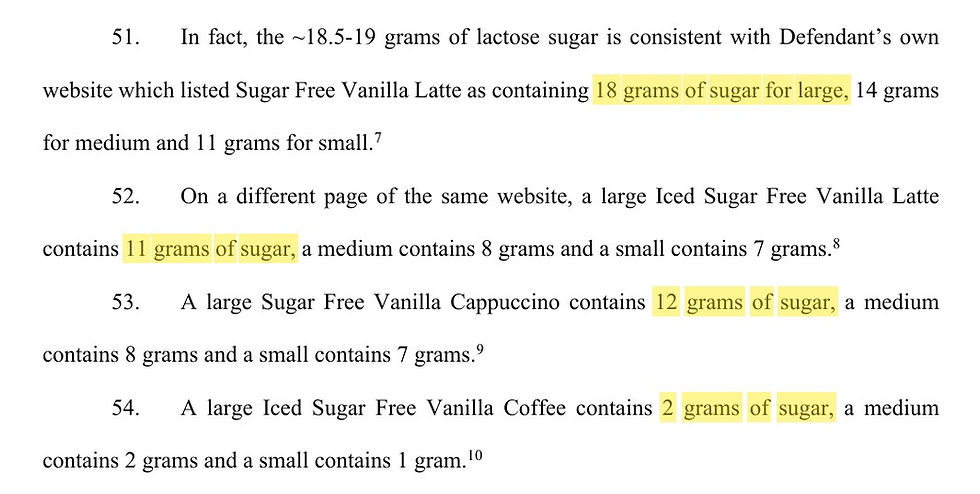
The complaint says McDonald's own website "listed Sugar Free Vanilla Latte as containing 18 grams of sugar for large, 14 grams for medium and 11 grams for small." It lists 11, 8 and 7 grams for the large, medium and small Iced Sugar Free Vanilla Latte; 12, 8 and 7 grams for the Sugar Free Vanilla Cappuccino; and 2, 2 and 1 gram for the Iced Sugar Free Vanilla Coffee.
Mercado says he paid about $4 for an Iced Sugar Free Vanilla Latte at a McDonald's in the Bronx in or about September 2026, after reading the drink's name on the menu board, and believed it "contained no sugar." He later learned the drink had at least 7 grams of lactose, the complaint says.
The lawsuit says McDonald's does not show the drinks' sugar content on in-store menus or signs, and that the self-service kiosk's "Nutrition & Ingredients" window lists calories by component but "does not state grams of sugar or lactose."
"Up to Thirty-Six Times" the FDA Limit
Under Food and Drug Administration rules, a food may be labeled "sugar free" only if it "contains less than 0.5 g of sugars" per reference amount customarily consumed and per labeled serving, among other conditions. The FDA defines total sugars as "the sum of all free mono- and disaccharides (such as glucose, fructose, lactose, and sucrose)."
The complaint says the drinks' sugar levels are "up to thirty-six times the FDA's threshold for labeling a product 'sugar free.'" It also says McDonald's never pairs the claim with a disclaimer such as "not a low calorie food," which the same FDA rule requires for "sugar free" foods that are not low- or reduced-calorie, and that the drinks range "from approximately 90 to 280 calories per serving."
The plaintiff says he is not trying to enforce federal food law directly, since it gives consumers no right to sue, but relies on the FDA standard as evidence that the claim is misleading under state consumer laws.
The complaint also says "the vast majority" of consumers do not know plain milk contains sugar, citing a 2024 study.
What the Plaintiff Is Asking For
Mercado seeks to represent a New York class, a nationwide class, and a class of buyers in 10 states: California, Florida, Illinois, Massachusetts, Michigan, Minnesota, Missouri, New Jersey, New York and Washington. The complaint says the aggregate amount in controversy exceeds $5 million.
It brings four claims: deceptive practices and false advertising under New York General Business Law sections 349 and 350, violations of the other states' consumer protection laws, and unjust enrichment.
The suit seeks actual and price-premium damages, statutory damages of $50 per violation under section 349 and $500 per violation under section 350, treble damages for knowing and willful violations, restitution, attorneys' fees and a jury trial.
Mercado is represented by James Chung of the Law Office of James Chung and by James C. Kelly and Anthony J. Russo Jr. of The Russo Firm.
McDonald's has not been found liable, and the allegations in the complaint have not been tested in court.
A Second Coffee-Chain Sugar-Free Suit This Month
The case follows a federal lawsuit filed Oct. 2 in Seattle that accuses Starbucks of selling "sugar-free" protein drinks that contain sugar, according to the Associated Press. Starbucks said the sugar in those drinks comes from the protein-boosted milk and that it does not add sugar. "We believe these claims have no merit," a Starbucks spokesperson told the AP.
TDFP has asked McDonald's and the plaintiff's attorneys for comment and will update this story.
Sources: Complaint, Mercado v. McDonald's Corporation, No. 1:26-cv-09142 (S.D.N.Y., filed Oct. 19, 2026): https://storage.courtlistener.com/recap/gov.uscourts.nysd.675322/gov.uscourts.nysd.675322.1.0.pdf ; 21 C.F.R. § 101.60(c)(1) (eCFR): https://www.ecfr.gov/current/title-21/chapter-I/subchapter-B/part-101/subpart-D/section-101.60 ; 21 C.F.R. § 101.9(c)(6)(ii) (eCFR): https://www.ecfr.gov/current/title-21/chapter-I/subchapter-B/part-101/subpart-A/section-101.9 ; Associated Press via Arkansas Democrat-Gazette, "Suit: Starbucks mislabeled 'sugar-free' protein drinks" (Oct. 6, 2026): https://www.arkansasonline.com/news/2026/oct/06/suit-starbucks-mislabeled-sugar-free-protein/


Comments