

TDFP Tweet Review (2026): The Report Card

By Yossi Schmidt
Tweet is the newest platform asking to be the internet's public square. It is built by Operation Bluebird, Inc., a startup founded by Michael Peroff, an Illinois trademark attorney. Its co-founders include Stephen Coates, a former Twitter trademark lawyer who now serves as the company's president and general counsel. It began as an attempt to revive the Twitter name itself. X Corp. sued. According to the company's own release, on September 4, 2026 a federal judge in Delaware granted X a preliminary injunction over the name "Twitter" but denied it over "Tweet" and the bird logo. The service has run as Tweet, at tweet.app, ever since, and the case continues.
Tweet is open on the web in Early Access, with an Android app "coming soon" and an iPhone app after that, according to its site. Its homepage claims "175,000+ handles requested," a company figure The Digital Free Press could not check. Coates told TechRadar in September that the platform had about 8,000 users. Tweet runs no ads and is funded by one-time memberships. Its founding document, the Birdhouse Constitution, makes some of the strongest free-speech promises I have read from any platform. This review asks whether the binding policies behind those promises live up to them, and how the product holds up in everyday use. At the end, Tweet gets a report card.
Terms of Service: The Contract vs. the Constitution
Tweet's Constitution says speech "is judged on conduct and legality, never ideology," and that users may express views "without fear of censorship based solely on disagreement." Its homepage says only "Threats, targeted harassment and illegal content are against Tweet's rules."
The Terms of Service, effective October 12, 2026, are what users actually agree to, and they go much further. Section 7 bars content that is "false, misleading or deceptive," "vulgar or offensive," or that "promotes discrimination, bigotry, racism, hatred, harassment or harm against any individual or group." It also bars content that "would give rise to civil liability or concerns by certain regulatory agencies." None of those terms is defined. Read literally, they cover lawful speech, including the categories legacy platforms call "hate speech" and "misinformation."
The Terms also let Bluebird remove content or suspend accounts "at any time and without notice," at its "sole discretion," for violating its policies "or any other reason." Notice is optional: the company has "the right, but [is] not obligated," to tell users when it removes or edits their posts.
Two other details stand out. Tweet's everyday rulebook is not public yet; the Constitution says "Community Guidelines, the everyday rules, arrive with the platform," while the Terms already bind users to "guidelines and policies that Bluebird provides from time to time." And the documents disagree on age: the Constitution says the platform "is intended for adults (17+)," while the Terms set the minimum at 13.
The Digital Free Press re-read Tweet's Terms, Privacy Policy, Constitution and Early Access pages on October 22. The effective dates and the language quoted in this review had not changed since our first read on October 16.
Content Moderation: Where the Line Is
The Constitution draws its own line in Article IV: "Users may criticize ideas, ideologies, governments, institutions, movements, and public figures. Users may not advocate violence, exclusion, or dehumanization of individuals or groups." Protecting criticism of ideas is the right instinct. But "exclusion" and "dehumanization" are not defined, and the document does not say whether arguing for lawful policies, such as limits on immigration from a given country, could count as advocating "exclusion."
On adult content the line is clear: "Explicit sexual imagery is not permitted in the public feed and is never recommended, amplified, or monetized." The child-safety page sets out procedures for child sexual abuse material and non-consensual intimate imagery, which every platform should have.
Reach and AI: Who Decides What Gets Seen
Tweet adopts the "freedom of speech, not freedom of reach" model. Its Constitution says lawful content "determined to be harmful, abusive, deceptive, manipulative, or disruptive may have its visibility reduced." The Terms list reducing "content's visibility or eligibility for recommendation" among enforcement options. The promise of notice covers removed content and restricted accounts, not reduced visibility, so a user may never learn a post was down-ranked.
The Terms and Privacy Policy also say Bluebird may use artificial intelligence to "assess the apparent authenticity, accuracy, reliability, context, or source" of public posts and to help "determine whether content should be labeled, restricted, reduced in visibility, referred for human review, or removed." To its credit, the company admits that "Automated assessments may be incomplete, inaccurate, or affected by context that is unavailable to Bluebird."
Tweet's fact-checking assistant is called Vera. The FAQ says, "Vera doesn't decide what's true; you do," and that it "never changes anyone else's" feed. Code in Tweet's public web app, which The Digital Free Press reviewed, includes settings that would tie a post's reach to Vera's rating and a "Civic Trust Score" for users. Much of that code sits beside clearly labeled demo screens, and the site calls Vera a roadmap item. We could not confirm that any of it is live. Asked about it, the company said Vera is "still in development, so code or concepts visible during development should not necessarily be understood as describing a final or currently deployed product." It described Vera as "the verification and scoring component," separate from the feed-customization tools it is building, and said it "will update public-facing descriptions as features are finalized."
Appeals and Due Process
The Constitution's User Bill of Rights includes the right to "Appeal moderation decisions," and Article VII promises that, "Whenever practical," users are told why action was taken, may appeal, and have major actions "reviewed by humans."
The Terms are softer: "If you disagree with our decision, we may provide an opportunity to request another review." Bluebird "may withhold notice or an appeal" in several situations, and its goals of acknowledging reports within five business days and resolving most within 30 days are, in its words, "operational targets rather than guarantees." Privacy requests are a bright spot: users who are denied can appeal by emailing legal@tweet.app.
Privacy and Data
Tweet's Constitution says users' clicks are "never sold to strangers." That promise does not appear in the Privacy Policy, effective October 14, 2026, which is the binding document. The policy says Google Analytics and the Reddit pixel are used to measure Tweet's advertising, and that when someone signs up, "we also tell them that a registration occurred and details on paid memberships." Bluebird says it does not share users' names, email addresses or other account information with those tools. Asked why Google and Reddit receive signup and membership details, the company told The Digital Free Press, "We use third-party services, including Google and Reddit, for advertising and analytics," and said it is "reviewing our public disclosures alongside our implementation to ensure they accurately describe those uses."
The content license is broad. Users grant Bluebird a "permanent, non-exclusive, transferable, worldwide, royalty-free license, with the right to sublicense," to use their posts "for commercial, advertising, and marketing purposes," to train artificial intelligence, "and for any other purposes Bluebird deems appropriate." Deleting a post "may not remove information, patterns, or improvements previously incorporated into a trained model or system." Asked whether it would narrow the license and let users opt out of AI training, the company said it is "reviewing these provisions" but does "not want to make a categorical commitment today that could conflict with legitimate future uses necessary to provide or improve the service." It said ideas for voluntary opt-in data or advertising uses, possibly with users "receiving value in return," are "exploratory rather than current commitments."
On government requests, Bluebird may disclose information to comply with "applicable law, legal process, or lawful requests" and to "cooperate with law enforcement." There is no transparency report yet and no stated promise to notify users of government demands.
On the plus side, Tweet does not require a phone number or government ID to sign up, and pseudonymous accounts are allowed.
Money and Ownership
Tweet sells one-time memberships: Founder for $20, Fighter for $40 and Centurion for $100, each with a badge. "There are no ads on Tweet today," the FAQ says. "Tweet is funded by its members." The FAQ also says plainly that membership is not an investment.
Joining is not free. During Early Access, the cheapest way in is the $20 Founder badge; the site's own pitch is that "members pay to join." Paying to verify that an account belongs to a real person is a reasonable trade, and many users would accept it. Paying just to get through the door is different. For a platform that wants to be the internet's public square, a $20 entry fee shuts out exactly the curious newcomers it needs, and it is a real barrier.
Two clauses matter for paying members. A member whose account is suspended or terminated for a policy violation is "not entitled to a refund," and Bluebird "may reject, change, reclaim, reassign, disable, or remove any account, handle, username, badge." Payments run through third-party processors, and the policies do not say what Tweet would do if a processor pressured it over lawful content.
Operation Bluebird is listed in its policies at an address in Fairfax, Virginia, with Delaware law governing its Terms. Coates told Ars Technica, "We are a small company, we have investors, and we have a product." In its written response to The Digital Free Press on October 26, the company said, "Tweet has been bootstrapped by a small group of people committed to building a better social platform, with support from friends and family." No investors or backers have been named publicly, and The Digital Free Press found no filings under "Operation Bluebird" in the SEC's EDGAR database as of October 16. TechRadar reported that member income pays a small team of about 10 employees and contractors.
Hands-On Tweet App Review: Pins, Games and Editing
Using Tweet day to day, a few features stand out.
Pinned posts: Tweet lets users pin up to three posts to the top of their profile. The app says so directly: "Pin up to 3 posts so visitors see your best work first." That is more than X, which allows one pinned post, according to its Help Center. Bluesky and Truth Social also allow one. Threads is the exception among the large X-style apps: Meta's official creators account on Threads says users "can only pin 3 posts at a time." Three pins is not unique, then, but it gives Tweet a practical edge over X for anyone who wants new visitors to see more than one post first.
Games: Tweet has a built-in Games section. Its first game, Twirdle, is a Wordle-style puzzle: guess a five-letter word in six tries. A new puzzle arrives every day at midnight Eastern time, players get a results page, and leaderboards rank players by number of guesses, then by time. A setting controls whether a player appears on those leaderboards. It was switched on in my account when I checked; I could not confirm whether that is the default for every new user. Daily games with leaderboards are not new to social media; LinkedIn, for example, offers daily puzzles that rank players against their connections. Twirdle is a pleasant extra and a reason to open the app each day, rather than a first.
Editing: Posts can be edited after they are published. Several major platforms already offer editing, so this keeps Tweet on par rather than setting it apart.
What Tweet Gets Right
Tweet deserves credit on several fronts. Its Constitution is written in strong pro-speech language: "Disagreement is not harassment," and "Fame, wealth, office, and follower count buy no special treatment." It runs no ads, allows pseudonyms, requires no phone number or ID, promises human review of major enforcement actions, and gives users advance notice of material changes to its Terms. Its arbitration clause includes a 30-day opt-out and a small-claims exception, which is fairer than most. It publicly admits the limits of automated moderation. And on the product side, three pinned posts and a daily game give users reasons to build a profile and come back.
My Experience: Early Days, Rough Edges
My own time on Tweet, mostly on the web app in October 2026, was less smooth than the features above suggest.
The web app was sluggish throughout my sessions. Pages and the feed were slow to respond, more than I expect from a text-first service.
Some basics are hard to find or missing. I could not find a list of the posts I had liked anywhere on my profile. Quote posts look like quotes in the feed, but on my own profile they are filed under Reposts rather than Posts, which makes my own commentary harder to find. There are no direct messages yet.
The feed mix also stood out. During my sessions, the default feed was heavy on posts sharply critical of President Trump, along with a large share of foreign content; one example was a reshared video about a bridge between North Korea and Russia. Tweet is small and still in Early Access, so the feed likely reflects who has joined so far, and it may change as the platform grows.
That leads to an opinion that is mine alone, as the reviewer, and not a finding of The Digital Free Press: "They always said Parler was a right-wing echo chamber. This is a left-wing echo chamber." It is an impression from my own feed, not a measurement. I will keep using Tweet and report the positives as well as the problems.
Before writing this review, I asked my followers on Tweet whether I should review the platform. In the final results of that poll, posted October 18 on my @yossishow account, 75 percent of 24 votes said yes and 25 percent said no.
What Tweet Told TDFP
The Digital Free Press emailed questions to Stephen Coates, president and general counsel of Operation Bluebird, on October 15, 2026, with a response deadline of Thursday, October 22. They were:
1. Does your platform allow all legal speech, including so-called "hate speech"? Where exactly do you draw the line? 2. Do you enforce your Terms of Service the same way for every user, or do some accounts get special treatment? 3. Who funds the platform? Who are your major investors or owners? 4. Have you ever removed, shadow-banned or limited content because of pressure from a government, advertiser or payment processor? 5. What user data do you collect, and do you sell or share it with anyone? 6. How do you handle user complaints and appeals, and how long does an appeal take?
On October 16, The Digital Free Press sent 17 follow-up questions based on Tweet's published policies, to Coates and to the company's legal address, covering the gap between the Terms and the Constitution, notice when reach is reduced, Vera's sources and any effect on reach, the unpublished Community Guidelines, appeals, transparency reporting, payment processors, investors, data sharing, the content license, paid badges, the commercial-use ban and the minimum age. On October 18 we added two more: whether Tweet plans a verification system for journalists and news outlets, and how it approaches viewpoint balance in the feed. On October 23, after the first deadline passed, TDFP extended it to Monday, October 26, at 5 p.m. ET.
Coates replied at 5:34 p.m. ET on October 26, writing that the company is "a small team" and that he "needed to coordinate with my colleagues." He passed on what he called "our response." The company wrote that "Tweet is still a young and evolving platform," adding: "Where a decision has not been finalized, we would rather be transparent about that than overstate certainty." It added that, like other platforms, it keeps "some internal operational details concerning content moderation and data practices that are not public, including details that could enable people to circumvent moderation systems."
Its key answers, quoted from the company's response:
All legal speech: "You asked whether Tweet will allow all legal speech. The answer is no." The company said "Tweet's policies prohibit certain content even where that content might be lawful, including content that violates our standards concerning hateful or abusive conduct," and that its "objective is to allow as much expression as reasonably possible."
Equal enforcement: "Our Terms and applicable policies are intended to apply consistently to users. Paid membership status does not provide an exemption from those rules."
Funding: "Tweet has been bootstrapped by a small group of people committed to building a better social platform, with support from friends and family." In August, Coates told Ars Technica, "We are a small company, we have investors, and we have a product." The company did not name its backers.
Outside pressure: Asked whether it has ever removed, shadow-banned or limited content because of pressure from a government, advertiser or payment processor, the company answered: "No."
User data and AI: The company said it collects "information users provide to us, along with information needed to operate, secure, moderate, and improve the service," and wants "to preserve appropriate flexibility for future product uses, including AI-enabled features." It added: "We do not want to make a broader promise here than our policies or future product requirements can responsibly support." Asked to narrow the content license and allow an AI-training opt-out, it said it is "reviewing these provisions" and does "not want to make a categorical commitment today." Ideas about voluntary opt-in data or advertising uses are "exploratory rather than current commitments."
Vera: "Vera is still in development, so code or concepts visible during development should not necessarily be understood as describing a final or currently deployed product." The company said it "will update public-facing descriptions as features are finalized so that our documentation accurately reflects how the product works."
Google and Reddit: "We use third-party services, including Google and Reddit, for advertising and analytics. We are reviewing our public disclosures alongside our implementation to ensure they accurately describe those uses."
Paid badges: "No. Paid badge tiers do not confer different moderation treatment or determine Vera scores."
Commercial use: Asked whether the "commercial purpose" ban applies to news outlets, creators and businesses, the company said: "No. We want businesses, brands, creators, news organizations, and communities to participate on Tweet." It said it has "a small-business program in development" and "will clarify our language where necessary."
Verification for journalists: "We are actively considering a separate verification approach for journalists, public figures, news outlets, and other notable accounts. The specific model and application process have not yet been finalized."
The company closed: "We welcome scrutiny and feedback, and where our current documentation does not yet reflect a final product decision, we will work to make those materials clearer as those decisions are made."
What Tweet did not answer: The response did not address our original question 6, on how Tweet handles complaints and appeals and how long an appeal takes. Of the follow-ups, it did not answer whether the minimum age is 13, as the Terms say, or 17 and older, as the Constitution says; how it defines "hatred," "offensive," "harm" and "dehumanization"; whether it will drop "or any other reason" and "without notice" from its removal terms; whether users will be told when a post's reach is reduced; which sources Vera treats as authoritative and whether users' posts are sent to Google; when the Community Guidelines will be published; whether appeals will be guaranteed; whether it will publish a transparency report or require legal process for government requests; what "concerns by certain regulatory agencies" means; what it would do if a payment processor demanded the removal of lawful content; whether Operation Bluebird has filed a Form D or raised money under any exemption; and whether it will put a no-sale promise in its Privacy Policy. It also did not directly answer our question on viewpoint balance in the feed, though it wrote, "Giving users maximum control over their feeds remains very much in scope."
Recommendations for Improvement
To match its Constitution and earn users' trust, Tweet should:
1. Align the Contract With the Constitution: Replace the undefined bans in Terms Section 7 ("offensive," "false, misleading," "promotes ... hatred ... or harm," "concerns by certain regulatory agencies") with the narrow line its homepage already states: threats, targeted harassment and illegal content.
2. Publish the Community Guidelines: Users should be able to read the everyday rules before they are bound by them.
3. Make Notice and Appeals Guaranteed: Drop "or any other reason" and "without notice," tell users every time a post is removed or its reach is reduced, and give every user an appeal with a deadline and a human reviewer.
4. Explain Vera Before It Affects Reach: Publish which sources Vera relies on and whether any rating, or any user score, changes how far a post travels. The company says it will update its descriptions as features are finalized; that update should come before any such feature goes live.
5. Put "Never Sold" in the Privacy Policy: Move the Constitution's promise into the binding policy, spell out what Google and Reddit receive, and let users opt out of AI training on their posts.
6. Publish a Transparency Report: Report government requests, removals, reach reductions and appeal outcomes, and notify users of government demands where the law allows.
7. Name the Owners: Disclose who funds the platform, including the "friends and family" the company says support it.
8. Finish Answering: Tweet answered 11 of our 25 questions on the record. It should also answer the rest, starting with how appeals work and how long they take, and whether the minimum age is 13 or 17.
9. Fix the Commercial-Use Clause in Writing: The company told TDFP the ban does not apply to news outlets, creators or businesses. The Terms should say so.
10. Fix the Basics: Speed up the web app, show users their own likes, list quote posts with their posts, and add direct messages.
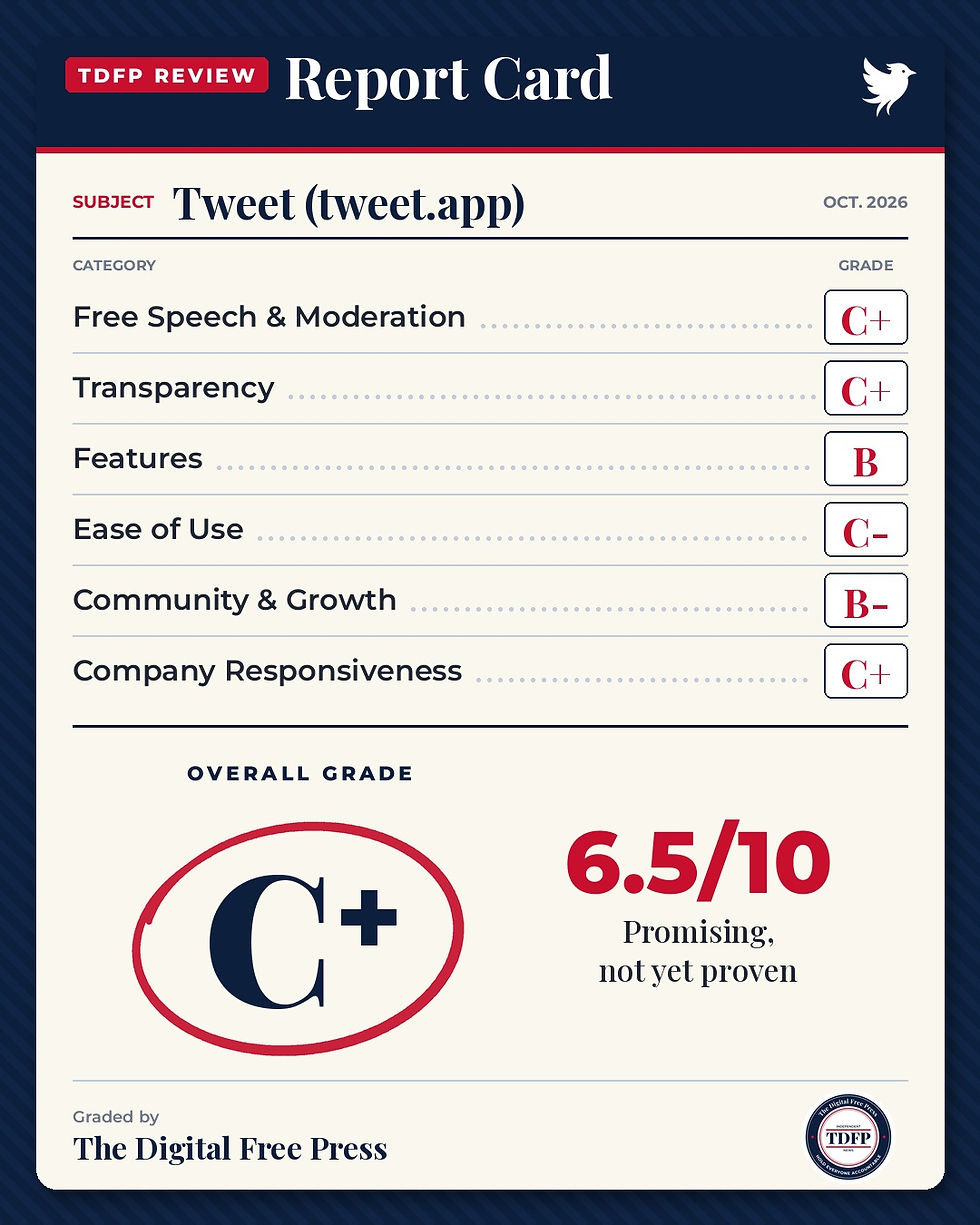
The Report Card
Free Speech and Moderation Policy: C+
The Constitution's promises are among the strongest anywhere, but the binding Terms ban "offensive" and "misleading" content and allow removal for "any other reason," and the company confirmed to TDFP that Tweet will not allow all legal speech. It also says paid membership buys no exemption from the rules and that it has never limited content under government, advertiser or payment-processor pressure.
Transparency: C+
Tweet publishes its founding principles, admits the limits of its AI, and answered on the record about its funding, Vera's status and the data Google and Reddit receive, with promises to correct its documents. There are still no public Community Guidelines, no transparency report, no named backers, and no notice when reach is reduced.
Features: B
Three pinned posts beat X's one, Twirdle gives people a daily reason to return, and posts can be edited; none of it is a first, and direct messages are missing.
Ease of Use: C-
The layout is familiar and signup needs no phone number or ID, but it costs at least $20 just to get in during Early Access, the web app was slow, there is no native app yet, and basics like a likes list are hard to find.
Community and Growth: B-
The company claims more than 175,000 handles requested (not independently verified) and has a clear no-ads, member-funded model, but it is early and the feed I saw was one-sided.
Company Responsiveness: C+
Tweet answered 11 of the 25 questions TDFP sent, in writing and on the record, on October 26, after the first deadline of October 22 had passed and TDFP extended it. It did not answer on appeals, the minimum age, Vera's sources or a transparency report, among others.
Overall: C+ (6.5/10)
RATING
Tweet gets real credit. Its Constitution is written for free speech, it runs no ads, it asks for no phone number or ID, it lets people use pseudonyms, and its three pinned posts and daily game give users something X does not. But the contract users actually sign is far stricter than the Constitution, with undefined bans on "offensive" and "misleading" speech, removal for "any other reason," appeals that are optional, and AI reach controls that are not explained. It also costs at least $20 just to join, a barrier for a platform that wants to be everyone's public square. The web app is still slow. The company did answer 11 of our 25 questions on the record, and plainly: asked whether Tweet will allow all legal speech, it said, "The answer is no." It also declined to rule out future AI and data uses of members' posts, and left our questions on appeals and the minimum age unanswered. That adds up to a C+, or 6.5 out of 10: promising, not yet proven. The grade reflects Tweet's documented policies, product and responsiveness, not politics, and it can rise quickly if the company closes the gap between its words and its contract.
Yossi Schmidt, Founder and Editor-in-Chief, The Digital Free Press
For any questions or information, you can email me. If you have a platform you'd like us to review, please reach out.
Sources: Tweet Terms of Service, Privacy Policy, Birdhouse Constitution, FAQ, Early Access, Child Safety, Status and About pages, and Tweet's public web app; Operation Bluebird release (GlobeNewswire); Ars Technica; TechRadar; SEC EDGAR; X Help Center; Instagram's @creators account on Threads; Bluesky public profile data and AT Protocol blog; Truth Social Help Center; LinkedIn Help.
Hold Everyone Accountable.



Comments