

TDFP Exclusive: New Postal Service Rule Lets USPS Bill Senders for Unpaid Foreign Customs Charges, Even on Lost Packages

The U.S. Postal Service will be able to bill people who mail packages overseas for foreign customs charges that go unpaid, and senders will have to pay even if they dispute the charge or the package never arrives, under a new rule set to take effect Monday, according to a Federal Register filing reviewed by The Digital Free Press.
The interim final rule, “Customs Requirements and Payment Procedures for Certain Customs Charges” (FR Doc. 2026-21310), was filed for public inspection Friday morning and is scheduled to be published in the Federal Register on Monday, Oct. 19. Because it is an interim final rule, it takes effect the day it is published. The Postal Service will take public comments for 30 days afterward.
WHAT THE NEW USPS CUSTOMS CHARGES RULE SAYS
The rule rewrites parts of the International Mail Manual, the Postal Service’s rulebook for overseas mail, and adds a new section titled “Unpaid Destination Customs Charges.”
Under that section, if a customs authority, postal operator, customs broker or customs representative in the destination country tries to collect duties, taxes or import fees from the sender or from the Postal Service, and those amounts have not been paid in full, “the Postal Service (or its representative) will send an invoice to the mailer for such amounts,” the rule says.
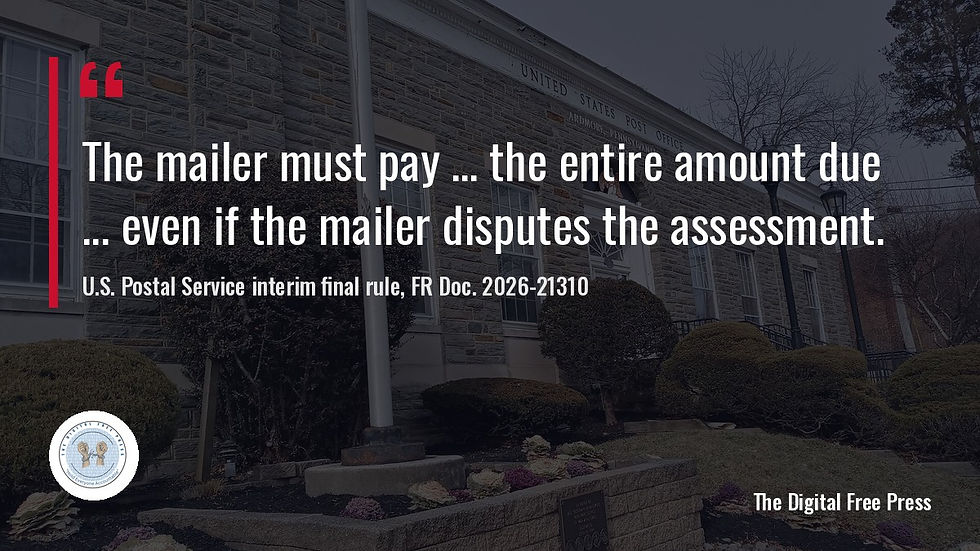
The sender must then pay “the entire amount due in accordance with the invoice terms, even if the mailer disputes the assessment,” according to the text. The rule adds that the sender “is not relieved of its obligation to pay for duties, taxes, and import fees, regardless of whether the item is delivered, lost, damaged, or returned.”
Late payers will owe more. If payment does not arrive by the invoice due date, “interest on the unpaid amounts will accrue at a rate of 6 percent per annum until the amounts are paid in full,” the rule says, and the Postal Service may also collect its own collection costs “to the extent permitted by applicable law.” It may, but is not required to, treat unpaid amounts as “revenue deficiencies” under its domestic mail rules.
The rule does not limit these charges to businesses. It applies to “the mailer.”
LIMITED RIGHT TO DISPUTE
The rule sharply limits what a sender can contest with the Postal Service. A mailer “may dispute with the Postal Service only accounting errors related to Postal Service invoicing,” by seeking a refund, the text says.
The Postal Service says it “is not responsible for the accuracy” of charges calculated by foreign customs, postal, law enforcement or tax authorities. Any challenge to the amount assessed abroad “must be addressed directly to such party without involvement from the Postal Service,” the rule says.
If a foreign party later cancels or refunds a charge the sender already paid, the Postal Service will pass the money back “if deemed practical in the Postal Service’s reasonable judgment,” according to the rule.
The rule also tightens senders’ paperwork duties. Senders must make sure customs forms are complete and accurate, and if they provide false or incomplete information, “the mailpiece may be returned or confiscated and the mailer may be subject to additional charges,” it says. Where a destination country requires duties to be prepaid, the sender “must send the mailpiece on a delivered duty paid basis,” the rule says.
WHY THE POSTAL SERVICE SAYS IT ACTED
In the filing, the Postal Service points to Europe. “As of July 1, 2026, the European Commission eliminated the de minimis exemption for most low-value goods” headed to the European Union, the agency wrote, and many European postal operators have since set their own requirements, including fees when customs information is inaccurate.
When a package is sent without prepaid duties and the charges “cannot be recovered from the addressee, the destination postal operator may seek to collect unpaid amounts from the mailer,” the Postal Service wrote. Duties, taxes and import fees “are not included in the postage paid by the mailer; therefore, the Postal Service may invoice the mailer for such applicable amounts when they have not been paid in full using USPS Delivered Duty Paid service,” according to the filing.
On its website, the Postal Service says that under the new European rules, business-to-consumer packages worth up to €150 and gifts worth more than €45 and up to €150 now face a flat, nonrefundable €3 duty per package, plus any country-specific taxes and fees. USPS says its Delivered Duty Paid service, which lets senders prepay those costs at the counter, through Click-N-Ship and through some USPS shipping software, is available for 18 countries, including Canada, the United Kingdom, Germany, France, Italy and Spain.
WHAT SENDERS CAN DO
The Postal Service’s own advice is to prepay. USPS “recommends that shippers prepay import duties, taxes, and fees whenever possible,” its website says, adding that in some cases a sender may be required to prepay in order to buy postage.
Comments on the rule can be emailed to PCFederalRegister@usps.gov with the subject line “Customs Requirements and Payment Procedures,” or mailed to the manager of Product Classification, U.S. Postal Service, 475 L’Enfant Plaza SW, Room 4446, Washington, DC 20260-5015, according to the filing. Comments are due 30 days after publication, which would be Nov. 18. The rule was signed by Jeffrey Boblick, an attorney in the Postal Service’s Ethics and Legal Compliance office.
As of Sunday morning, The Digital Free Press found no news report on the rule.
Sources: U.S. Postal Service, interim final rule “Customs Requirements and Payment Procedures for Certain Customs Charges,” 39 CFR Part 20, FR Doc. 2026-21310 (filed for public inspection Oct. 16, 2026; scheduled for publication Oct. 19, 2026), via the Federal Register; USPS, “Prepaid Import Duties” (usps.com). Cover photo: USPS mail truck, by IFCAR, public domain, via Wikimedia Commons. In-post image background: U.S. Post Office in Ardmore, Pennsylvania, by Kreuz und quer, CC0, via Wikimedia Commons.


Comments